
A message from Tanya Gaw, Founder of Action4Canada
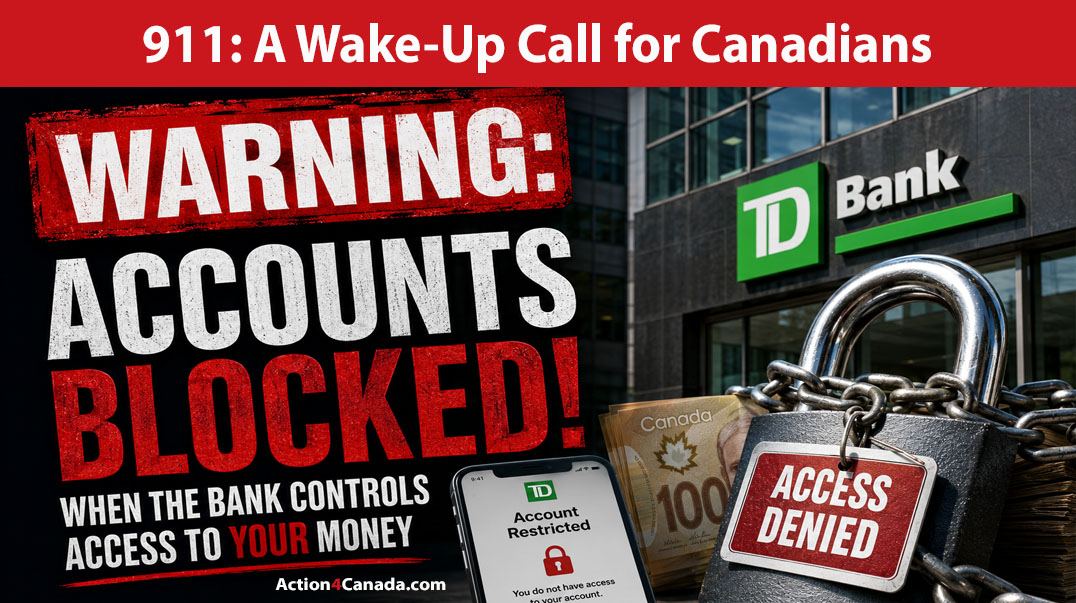
What began as a routine decision by my mother to withdraw her own money escalated into a disturbing three-week ordeal that every Canadian should know about. I am making our experience with TD Bank public not simply because of what happened to us, but to warn Canadians about how quickly access to your own money can be taken out of your hands; to expose the serious questions this raises about the limits of a financial institution’s authority; and to help educate Canadians and provide practical steps you can take now to protect your financial independence, privacy and access to your money. (scroll to the bottom to hear an interview highlighting the details of this matter).
Canadians already witnessed bank accounts being frozen during the Freedom Convoy, demonstrating how financial institutions can become a powerful instrument of control. But what happens when there is no protest, no emergency order and no allegation of criminal wrongdoing—when an 85-year-old woman simply wants to withdraw her own money?
For three weeks, my 85-year-old mother and I lived through a nightmare experience with TD Bank that underscored everything Action4Canada has been warning about regarding the importance of cash, financial independence, maintaining control over your own money, and protecting and limiting access to your personal and financial information.
Recently, these concerns were further reinforced when A4C reported on the major cybersecurity breach involving the Canadian Investment Regulatory Organization (CIRO), which compromised the personal and financial information of 750,000 Canadian investors, including my mother. During our dealings with TD, I provided information regarding the CIRO breach to explain the legitimate privacy and security concerns underlying my mother’s decision to withdraw lump sums of her own money and maintain greater control over her finances.
Her decision was not the result of fraud, money laundering, coercion or someone directing her what to do. It was her own informed decision about her own money.
Our experience confirms how important it is for Canadians to understand their rights, maintain financial alternatives and be prepared.
What Happened?
My mother is 85 years old, competent and fully capable of managing her own financial affairs. Approximately two weeks before this incident escalated, she had made several lump-sum cash withdrawals from her own account for personal reasons. She was questioned by branch staff each time and made it clear she was not being coerced or defrauded.
On Wednesday, July 22nd, my mother attended TD Bank to make another withdrawal. Bank staff once again began questioning her about why she wanted the cash and what she intended to do with it. My mother clearly explained that the money was for personal reasons and repeatedly confirmed that no one was coercing her, she was not under duress and she was not being defrauded.
Despite those answers, the questioning continued. My mother made it clear that what she intended to do with her own money was personal and, beyond establishing that she was acting voluntarily and was not the victim of fraud, “it was none of the bank’s business.” My mom was instructed to return on Friday to receive the requested funds.
However, on July 23rd she was contacted by the TD Fraud Department. We were completely unaware of the reason. We immediately went to the bank and met with the branch manager, Mr. Charn Sangha, and discovered that he had escalated the matter to the Fraud Department without my mother’s knowledge. We explained the CIRO situation and my mom’s decision to remove her funds, which led Mr. Sangha to place another call to the Fraud Department in an attempt to clear up the matter. Things quickly spiralled out of control and a decision was made to freeze my mom’s account. The experience became extremely upsetting for her and culminated in Mr. Sangha ordering her to leave the bank. Because my mother was jointly listed on my accounts, they were also frozen.
What followed were three weeks of daily meetings, telephone calls, repeated explanations and attempts to determine why this had happened and by what authority TD was continuing to deny us access to our accounts. It was all consuming as we were forced to spend hours dealing with it every day.
We fully cooperated. We met with TD representatives, including individuals from TD’s CARES Department and a bank manager from another branch, and we repeatedly explained the circumstances surrounding the withdrawals. Yet we remained without access to our money and without a satisfactory explanation identifying the legal or regulatory authority upon which TD was relying.
Then the situation escalated even further.
On Monday, August 10th, and again on Tuesday August 11th, we were informed that TD intended to permanently close my mother’s accounts and “de-market” her as a customer. I demanded to know on what grounds this extraordinary decision had been made. A reason could not be provided to us. I therefore demanded that the matter be escalated to someone with greater authority, and the representative agreed that it should be.
On Wednesday, August 12th, I unexpectedly received a telephone call from Sebastian, who identified himself as the manager of TD’s Fraud Department. He initially confirmed that my mother would no longer be permitted to bank with TD. But as we spoke, it became apparent that he did not have the complete facts of the case. I once again explained what had occurred on July 22nd, the circumstances surrounding my mother’s withdrawal, the assurances she had provided, the escalation by the branch manager, the regulatory concerns we raised with TD, and everything we had endured during the three weeks that followed. After hearing the circumstances, Sebastian asked me to give him approximately 30 minutes so that he could review the matter and then he would telephone my mother directly regarding her case.
When he called my mother, he immediately informed us that our accounts had been released. He apologized and acknowledged that the matter should never have reached this point.
After three weeks, we finally had access to our money again.
Think about that for a moment.
Your money is sitting in a bank account. You have committed no crime. You cooperate with the bank and clearly state that you are not being defrauded, coerced or acting under duress. Yet access to your money can be restricted while you are left desperately trying to determine why, who authorized it, what evidence justified it and when you will regain control of your own funds.
And in our case, after three weeks of fighting the decision, a senior manager finally reviewed the circumstances, reversed the restriction and acknowledged that it should never have gotten this far.
There Are Limits to Their Authority
Banks have important responsibilities to identify and respond to genuine fraud, money laundering and financial abuse. We do not dispute that. Indeed, protecting elderly and vulnerable customers from genuine financial exploitation is important.
But their authority is not unlimited.
Canada’s Bank Act establishes important protections surrounding Canadians’ access to basic banking services. Section 627.17 generally requires member banks to open retail deposit accounts for consumers who meet the prescribed requirements. Although the Act provides limited exceptions, including where a bank has reasonable grounds to believe an account will be used for illegal or fraudulent purposes, the Financial Consumer Agency of Canada (FCAC) has made clear that a bank relying on that exception requires evidence establishing those reasonable grounds; mere suspicion is not enough.
Privacy protections are also relevant to what happened to my mother. Under PIPEDA, Canada’s federal private-sector privacy law, organizations may collect, use or disclose personal information only for purposes that a reasonable person would consider appropriate in the circumstances. Its principles also require organizations to limit collection of personal information to what is necessary for the purposes identified.
That matters when a customer has already answered the legitimate question: Are you being defrauded, coerced or acting under duress? At what point does continued questioning about what a competent adult intends to do with her own money cease to be reasonable fraud prevention and become an unnecessary intrusion into her private affairs?
Likewise, FINTRAC’s anti-money-laundering framework does not make the simple act of withdrawing your own cash proof of criminal activity. Suspicious transaction reporting requires consideration of facts, context and indicators that together establish reasonable grounds to suspect a transaction is related to money laundering or terrorist financing.
A bank may therefore have legitimate grounds to ask reasonable questions when genuine warning signs arise. But there must also be reasonable limits to how far that scrutiny can go.
Once a mentally competent adult has cooperated, denied fraud, money laundering or coercion, and confirmed that she is voluntarily making decisions about her own money, what is the reasonable limit of a financial institution’s authority?
Our experience demonstrates why that question urgently needs an answer.
TD Bank: From Money-Laundering Failures to Overreach?
There is another disturbing dimension to this story.
In October 2024, TD in the United States pleaded guilty to criminal charges involving violations of the Bank Secrecy Act and conspiracy to commit money laundering, resulting in US$3 billion in combined penalties. Bharat Masrani, the Canadian-based Group President and CEO of Toronto-Dominion Bank, left the top job following the scandal. He publicly stated that the AML failures occurred on his watch and that he took responsibility for it.
In response to money laundering, fraud and other financial crimes, banks have implemented increasingly aggressive monitoring, fraud-prevention and compliance procedures. TD’s own terms allow transfers to be held or blocked for fraud, risk, compliance or other “reasonable” grounds.
The critical question is whether those powers and procedures are now being weaponized so broadly that legitimate customers conducting lawful transactions are being caught in the net—and, in a growing number of cases, denied access to their own money.
My mother’s experience is not the only warning I have received. Two separate precious-metals dealers have told me directly about customers encountering serious resistance from financial institutions when attempting to transfer their own funds to purchase physical gold and silver, including blocked or delayed transfers and, in some cases, accounts subsequently being closed. These reports deserve greater public scrutiny.
Consider this a 911 call to Canadians: the time to reconsider how much control banking institutions have over your money and investments is now—not after your access has been restricted or you find yourself caught in the midst of a potential bank run. Take action while you still have choices. Review the Cash is King section below for practical steps you can take to protect your financial independence.
A Wake-Up Call for Every Canadian
For years, Canadians have been encouraged to embrace debit and credit cards, online banking, automatic payments and increasingly cashless transactions because they are convenient. In the process, we have gradually surrendered physical possession of much of our money in exchange for electronic access to it.
But electronic access is not the same thing as possession.
When virtually everything you have depends upon a financial institution granting you electronic access to your account, what happens when that access suddenly disappears?
This is precisely why the discussion about cash, Digital ID, CBDCs and centralized financial control matters. The danger is no longer merely theoretical when ordinary people can suddenly discover that having money in an account does not necessarily mean having immediate access to it.
Accountability and Change Are Still Needed
While we are relieved that our accounts have finally been released, what happened over these three weeks cannot simply be dismissed and forgotten. During my discussions with both TD’s CARES representative and the manager of the Fraud Department, I made it clear that protecting customers from fraud is important—but those safeguards cannot come at the expense of treating long-standing, law-abiding customers with suspicion and disrespect, or denying them access to their own money without adequate justification. TD must do a better job of training its managers and staff to understand both their responsibilities and the limits of their authority.
What my mother and I were put through was egregious, stressful, humiliating and, in my view, a serious injustice. For my 85-year-old mother in particular, the experience was deeply upsetting. Banks risk losing the very customers they claim to be protecting when fraud-prevention measures become unreasonable and punitive. No Canadian should have to endure this kind of treatment simply for seeking lawful access to their own money.
TD ultimately apologized and acknowledged that the matter should never have reached this point, but that does not erase what happened. Serious questions remain about the authority under which these decisions were made, and the harm that can result when financial institutions exercise such extraordinary control over law-abiding customers.
We intend to continue pursuing answers and accountability. This matter is not over, and further action is forthcoming.
Cash is King
Our experience should serve as another warning: be prepared.
Important Note: This message is not a call to stop using banks altogether nor is it financial advise. In today’s economy, most individuals and organizations—including Action4Canada—still depend on conventional banking services for essential transactions. The warning is about becoming completely dependent on them.
Take practical steps now to protect your financial independence:
- Protect cash. Use cash regularly and maintain a reasonable amount of emergency cash outside the banking system. Having cash on hand is what enabled me to continue paying essential bills while I was locked out of my accounts. Because my bill-payment accounts were already established, I could take cash into the bank and have those bills paid. Where available, I could also go directly to a service provider and pay in person. Old school? Absolutely. But when my digital access disappeared, cash gave me options.
- Reconsider where you keep your wealth. Carefully consider how much of your money and investments you want to maintain within banking and purely digital financial systems. Consider whether diversifying a portion into physical assets, including gold and silver, may be appropriate for you. You know the saying, “If you can’t touch it, you don’t really own it“. It’s worth considering.
Purchasing physical precious metals: Connect with Steve Merrill, visit Action4Canada’s Purchasing Precious Metals page HERE. - Keep paper bills and statements. Don’t allow companies to automatically push you into paperless billing. If you lose access to the internet, email or an online account, a paper bill tells you what you owe, when it is due, your account number and who needs to be paid. Combined with cash, it gives you an offline backup when digital access fails.
- Protect your privacy. Limit unnecessary access to your personal and financial information. Be cautious about how much information you provide, where it is stored and who has access to it.
- Reduce your digital dependence. Don’t rely exclusively on debit and credit cards, automatic payments, online banking or paperless billing. Maintain practical alternatives wherever possible.
- Use Pre-Paid credit cards. Available in grocery stores. Only deal with reliable sources.
- Bank machines. When withdrawing larger sums of cash use bank machines. Make daily withdrawals without the headache of dealing with tellers.
- Multiple bank accounts. Consider opening an account at another bank as back up.
- Know your rights. Understand the ‘reasonable’ limits of a financial institution’s authority and ask questions when those limits appear to have been exceeded. Don’t be afraid to challenge decisions and demand to know the authority upon which they are being made.
- Be prepared. Don’t wait until your access is interrupted to discover how dependent you have become on the system.
If we allow cash to disappear, we will be participating in the creation of the very kind of cashless financial infrastructure capable of controlling who can buy and sell—a system Scripture warned about thousands of years ago.
Precious Metals: Securing Your Investments

As concerns about our banking institutions increase, it is important to remain calm, informed and take practical steps to protect your assets. Action4Canada is not providing financial advice. We are alerting you to real-life situations and providing alternatives for you to consider.
If you decide that owning physical precious metals is right for you, we invite you to learn more about purchasing through Steve Merrill of Sun City Silver. Steve has been a trusted friend of the freedom movement for many years and offers A4C members highly competitive pricing. Every purchase made through Steve also supports Action4Canada, as he contributes a portion of each sale to help advance our mission of defending Faith, Family, and Freedom. To learn more about purchasing precious metals through Steve Merrill, view HERE.
Interview on Talk Truth with Tanya Gaw
Interview on This Week in Money with Guest Tanya Gaw
Action4Canada is having a significant impact in overturning radical ideologies and defending Faith, Family, and Freedom. Your support is vital to this mission. Every dollar you give is carefully stewarded to maximize its impact in protecting Canadian sovereignty, preserving our rights and freedoms, and upholding the Christian biblical principles and values that form the foundation of our nation. We invite you to partner with us by making a one time gift or by becoming a monthly supporter. Together, we can continue to bring hope and real solutions to Canada.
If you are in need of prayer please reach out to our Prayer Team at [email protected]
Remember: Freedom of speech, thought, belief and the right to life, liberty and security of the person are guaranteed. We do not need to beg, barter or ask for them…they are ours for the taking.
God bless you and God bless Canada!
The Team @
Action4Canada